Introduction: with how many people can you play cornhole?
One of the big advantages of cornhole is that you can play it with almost any group size. From a 1 vs 1 game to large tournaments with dozens of participants: there is always a suitable cornhole format. In this guide we explain how many people can participate at the same time and which game formats are most commonly used.
Singles (1 vs 1): ideal for practice
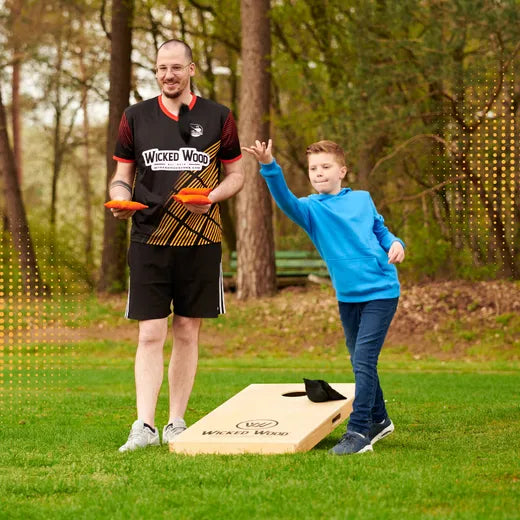
The simplest form is singles: one player against one player.
- Each player has four bags of the same color;
- You throw alternately towards the same board;
- After the round you walk to the other board and throw back from there.
Singles is perfect for working on your throwing technique and really mastering the cornhole scoring system. It’s also the format in which many players test their own level.
Doubles (2 vs 2): the most popular form
The most commonly played competitive format is doubles: two against two.
How does doubles work?
- You form two teams of two players;
- One player from each team stands at one board, the other at the other board;
- You always throw against the player from the other team who is standing at the same board as you;
- After each round the points are counted and the throwing direction changes.
Doubles makes cornhole extra fun because you play together with a teammate. You can coach each other, encourage each other and determine strategy together: do you play it safe on the board, or go for a bold airmail?
Crew or team format (3+ players per team)
Do you have many players but only one or two sets? Then a crew format is ideal. In this case several people play on the same team.
Example crew format
- Teams consist of 3 or 4 players;
- Players take turns per round or per bag;
- Everyone gets the chance to throw and to have a turn.
This format is popular for company outings and larger family parties. It’s more about fun and team spirit than about pure competition.
Party and rotation formats for large groups
For birthdays, neighborhood parties or festivals you often want many people to be able to join in briefly. A winner-stays-on or rotation system works well for this.
Winner-stays-on
- Two players or teams start at the board;
- The winner stays, the loser makes way for a new challenger;
- This way you keep playing short, dynamic games.
Rotating partners
- New teams are formed every round;
- You keep playing with and against different people;
- Fun for mixing within a large group and getting to know new people.
Solo practice: yes, that’s possible too
Even if you’re alone, you can easily practice cornhole.
- Set up the boards at the correct distance;
- Throw all eight bags from one side;
- Walk to the other side, count your score and throw back.
Many players use solo training to refine their throwing technique, try out new ways of throwing or simply to relax for a bit.
Which cornhole game format suits your group?
As a rule of thumb, you can use the following:
- Small group (2–4 people): play singles or doubles.
- Medium-sized group (4–10 people): doubles with rotation or crew format.
- Large group (10+ people): winner-stays-on, tournament or multiple sets side by side.
The more players you have, the more important it becomes to agree on clear rules, a playing schedule or a small tournament format. If you really want to organize an event, also check out our guide Cornhole tournaments and organization.
Frequently asked questions about player numbers in cornhole
With how many players can you play cornhole?
By default you play cornhole with 2 or 4 players (singles or doubles). With creative formats you can easily play with larger groups, for example with teams of 3 or 4 or with rotation formats.
What is the difference between singles and doubles in cornhole?
In singles you play 1 vs 1 and each player throws all the bags from both ends. In doubles you play 2 vs 2, with teammates standing opposite each other at the boards and throwing alternately.
Can you play cornhole with more than 4 people at the same time?
Yes, for example with a crew format in which several people are on one team and take turns each round. You can also use a rotation system where winners stay on and new players keep joining in.
Can I practice cornhole alone?
Absolutely. You can set up the boards at the correct distance and throw all the bags from one side. Then walk to the other side, count your score and throw back. This way you improve your throwing technique and consistent line. Check out our Cornhole Hub
for more information.Which game format is best for a party?
For parties a winner-stays-on or rotation format usually works best. You play short games and many different people get the chance to join in for a bit, without long waiting times.